How three connected meters found Palomar Mountain's missing water
Palomar Mountain Mutual Water Company used to hunt for lost water by hand. Its first three connected meters traced an open valve from the office, then put a leak on the customer's side of a shut-off without digging.
By Resource Monitor
·
November 18, 2026
·
4
min read
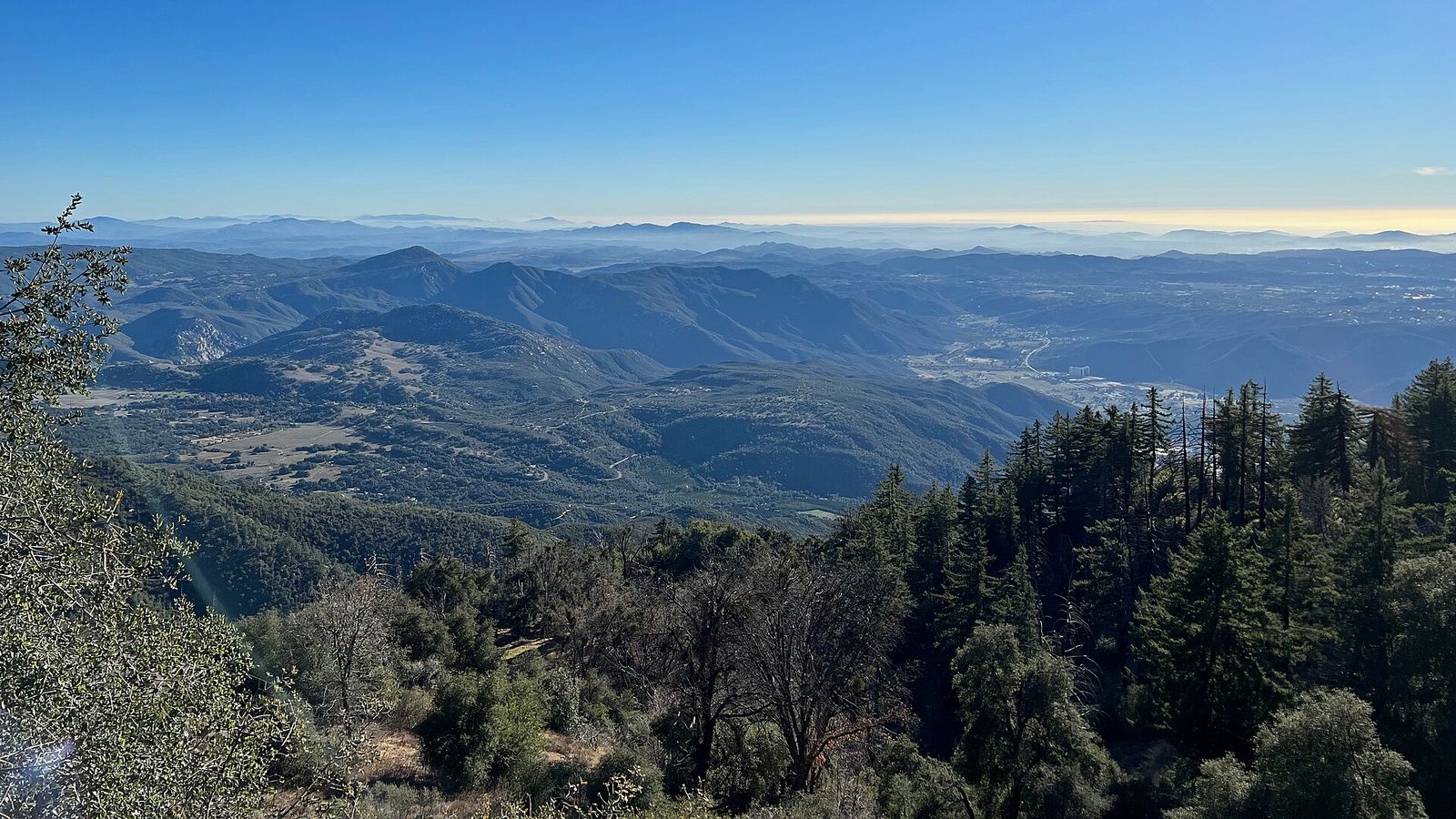
The view from Palomar Mountain State Park in San Diego County, California. Photo: Z3lvs, CC0, via Wikimedia Commons.
At a glance
Customer
Palomar Mountain Mutual Water Company
Location
Palomar Mountain, California
Challenge
Finding lost water meant checking a mostly analog system by hand, and there was no way to tell where on a line a leak sat
Results
In fire season, an open valve was traced from the office and confirmed in one short field check. A leak on one property was pinned to the customer's side without digging
Before the meters
Palomar Mountain Mutual Water Company runs a small water system on Palomar Mountain in San Diego County, California. Until recently, nearly every meter in the system was analog. When the general manager suspected the system was losing water, the only way to find where was to check the meters by hand, a job that takes two people 8 to 10 hours for the full system.
The company decided to move to connected meters, which send their readings over the cellular network on their own instead of waiting for someone to walk out and read them. Its first three went in as test meters.
The open valve
At the end of June, heading into the Fourth of July weekend, the general manager checked the storage tanks one morning and saw that the system had used almost twice as much water as usual over the previous 24 hours. On a system like Palomar's, that usually means a leak, and finding it would have meant checking analog meters across the mountain. By her estimate, a search by hand was headed for about 20 staff hours.
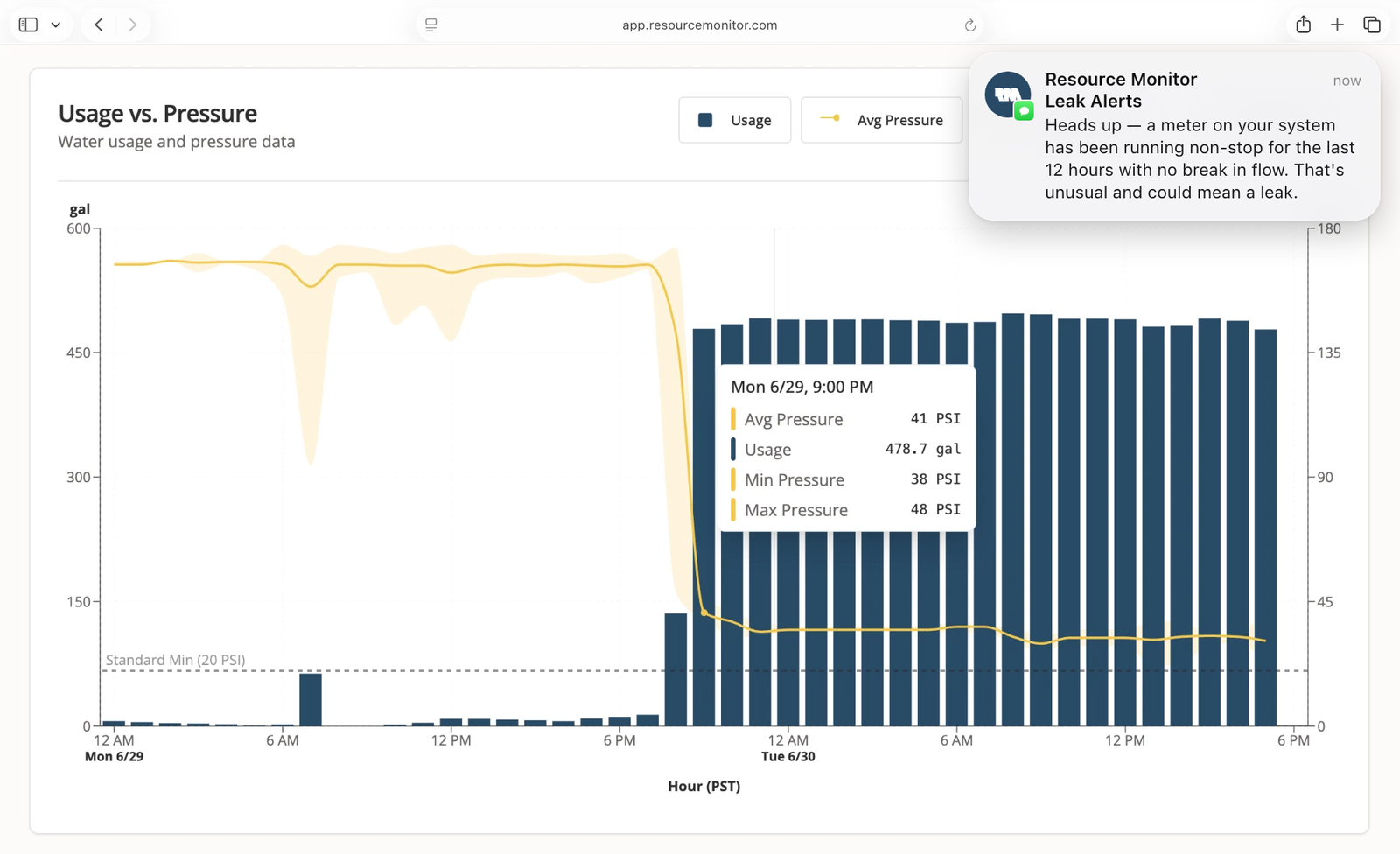
Before starting that search, she checked the three connected meters. Their readings showed the fire department drawing a steady 500 gallons an hour, and it had been running since 9 p.m. the night before.
The app's hourly view from the night the valve was left open. Bars show gallons used each hour and the line shows water pressure. Use jumped at about 9 p.m. on June 29 and held near 500 gallons an hour.
The timing made her careful. It was fire season, there had been fires in the area recently, and the holiday weekend was coming. Heavy use by the fire department could have been intentional, so the staff kept watching the readings into the early afternoon. Once it was clear the flow was more than the fire department's storage tank could hold, they called. Someone had forgotten to close a valve the night before.
On a mountain in fire season, water running out of an open valve is water that isn't in storage if a fire starts.
Instead of a day spent searching, the work came down to checking the meter data online a few times, a few phone calls in the afternoon, and one final meter check in the evening that took less than 15 minutes.
"Having this equipment fundamentally changes how we can operate in a profound way that significantly reduces costs and efforts related to monitoring, maintaining, and repairing our water system."
General Manager, Palomar Mountain Mutual Water Company
A leak found without a shovel
The meters also helped with a different kind of leak, on the line serving one family's house. Water was running constantly, and nothing showed where along the line it was coming from. Leaks like that are usually found by digging, and when nobody finds them, the water is written off as loss.
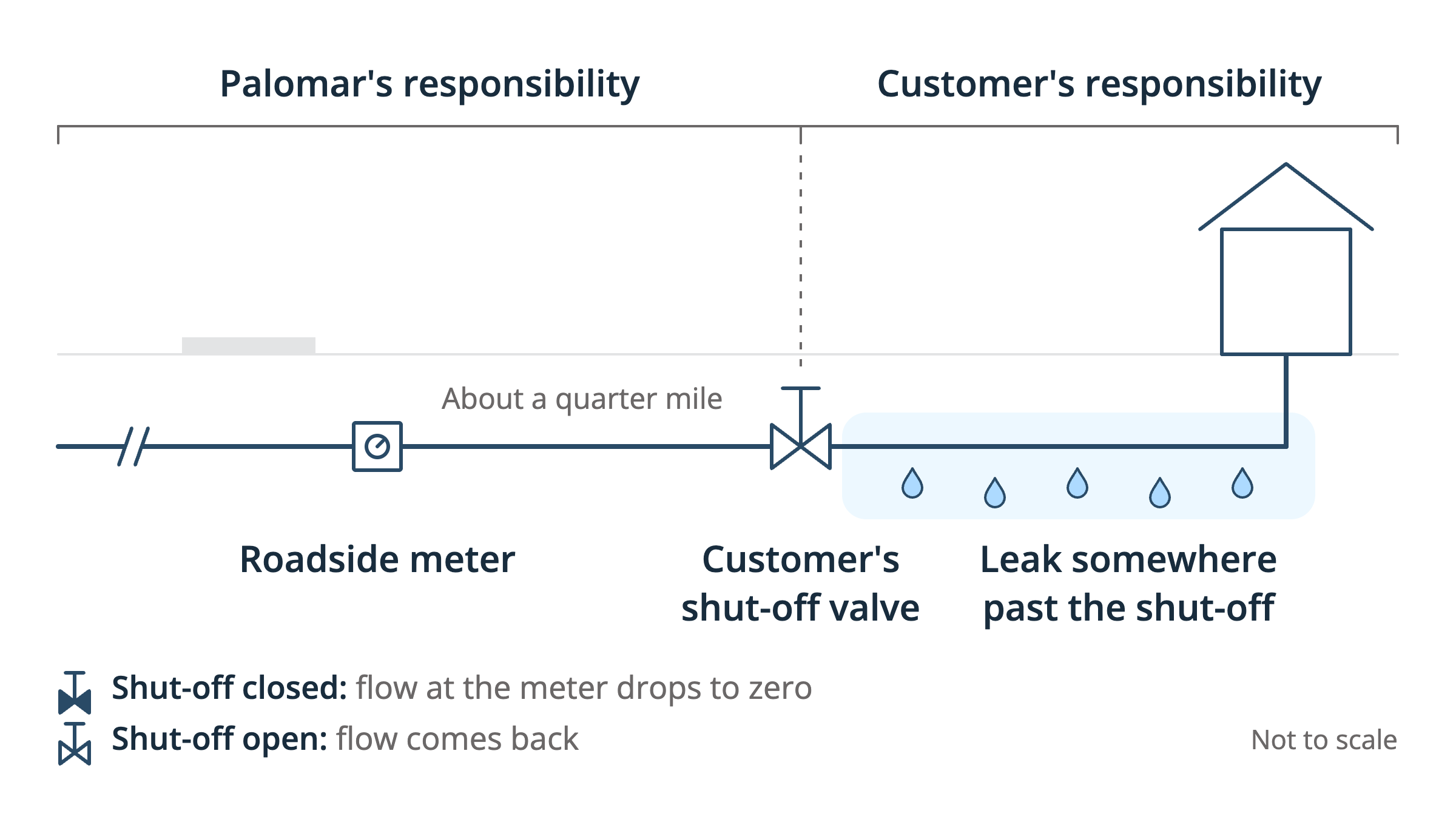
On Palomar's system, where the leak sat also decided who paid for it. Years ago the company moved many of its meters out to the roadside, so it owns the pipe from each meter to the customer's shut-off valve. On this property, that pipe runs about a quarter mile. A leak there would be the company's loss. A leak past the shut-off would be the family's.
The company owns the pipe from the roadside meter to the customer's shut-off valve. Closing that valve stopped the flow, which put the leak on the customer's side.
The meter on that line reports often enough to show a trend, and its readings showed the flow climbing from about 0.1 to nearly 0.4 gallons a minute. Staff went out, closed the customer's shut-off, and watched the meter. The flow dropped to zero. When they opened the valve again, the flow came back. In about 15 minutes they knew the leak was on the family's side, and nobody had to dig to learn it.
That settled who was responsible, and the readings showed how much of the family's bill came from the leak instead of leaving it to guesswork. Three weeks later the leak was running near 500 gallons a day and still growing.
The mile between the wells and the tanks
Palomar has since added meters on both of its wells. Almost a mile of pipe runs between the wells and storage. Before, the company metered only at storage and had to trust that what left the wells arrived. Now the readings at both ends agree, so the company knows that stretch of pipe isn't leaking.
Meters on both wells now check what leaves the wells against what arrives at storage, almost a mile away.
A low-pressure alert on one service also led the general manager to a leak at a resident's property. She contacted the resident, who had the water shut off for the repair.
What it still takes, and where it's going
The meters don't fix anything on their own. In both cases, Palomar's staff still made the calls and went out to confirm what the data showed. On the property leak, the readings narrowed the problem to one side of a valve, not to an exact spot in the ground. What changed is that the staff knew where to look before they left the office.
That precision comes from volume. Each connected meter reports every 15 minutes, which is 96 readings a day, where an analog meter gives one reading a month. Palomar's contract covers 231 meters, and once all of them are reporting, the system will produce more than 22,000 readings a day.
Flow and pressure together make those readings sharper. Flow shows how much water is moving and when. Pressure shows where the system is straining. Steady overnight flow on one meter points to a leak or an open valve, and a pressure drop on one service points to a break nearby. Across hundreds of meters, a problem can be narrowed to one line, one zone, or one side of a valve, often before a customer notices.